
Date added: 28/12/2025
A plan without a goal

Reflection and analysis are the domain of the lost. Let’s leave them to the philosophers.
(my own translation from original)
Andrzej W. Sawicki “Szpony i Kły”
Some texts refuse to appear immediately after the experience they describe. Sometimes, the clusters of thoughts, collected for weeks in the margins of notebooks, are difficult to organize. Any reason seems like a perfect excuse to return to my daily routine and allow myself to be distracted, due to a seeming lack of time. After all, what harm could one more day of delay do? Why force myself? Better to heed the tea rat’s prophecy – “Don’t control it, allow it.”
And now. The spell has worked. I settle into an unbearable comfort zone. It effectively avoids the prospect of extra hours sitting in front of a screen, writing, and proofreading, but it still stings and itches. Something demands closure. The weight of an unfinished task.
Although this is work under my own pressure, I try to endure the understatement. I give myself the privilege of time to reflect and get lost in the threads. I’m discovering that, in the case of creative endeavors, a longer vegetative period can sometimes be beneficial. Sometimes it’s a moment of sitting under the burden of unfinished work and moving on to other things. Other times, it’s a few unsuccessful drafts and abandoning the attempt. Eventually, however, there comes a moment of convergence of seemingly random factors that unlock the suspended issues, revealing new perspectives. It’s an unforced, sudden signal that calls for the integration of thoughts into a coherent narrative. All the approaches taken so far finally begin to work together. Not because they have to, but because they’re ready.
Just like today.
The Journey so far
A few, maybe a dozen, minutes after the Facebook event about the autumn metal sculpture course appeared, I was already registering my interest. Rather impulsively, I didn’t want to miss the opportunity and lose my spot. Furthermore, I had already gotten to know the Łódź Sculpture Workshop this year and the work of course leader Maciek Kus, so I had no doubt it was worth it. I also had no previous experience with the titular “cutting, bending, and welding,” which meant I had no specific expectations. Well, maybe, except that, as always, I aimed to create a work that was representative of me, one that would have meaning and significance for me.
At the beginning of November, after returning from an intensive week of sculpture in Łódź, I reported with a series of photos that I had arrived, practiced, and carved… and then quickly moved on to new topics. In the following weeks, as I wandered between one task and the next, I reflected on my past experiences. Two themes struck me as particularly interesting – the role of the creator as the “smith of one’s own fate” and the idea of form that can defend itself. A bit like Witkacy’s pure form theory ? Perhaps.
The symbolic blacksmith and the quite real steel form haunted me, but I couldn’t describe them satisfactorily. Something still didn’t fit. All attempts at analysis seemed shallow or overwrought.
I even began sketching texts referencing visually similar forms to mine, created by various primitive peoples (for example, the ritual masks of the Dogon in Mali). I sought understanding in the craft itself, including in the qualities commonly attributed to blacksmiths, such as determination and self-improvement. I read mythological tales about Hephaestus and Svarog, trying to apply a universal meaning to these figures for today. Everything turned out to be a road to nowhere. Overcomplicated.
“It was supposed to be Pathos, but it turned out to be Portos,” to quote a YouTube classic of Polish B-movie reviews.
Meanwhile, weeks passed and the holidays arrived. I slowly sank into a gingerbread hibernation when suddenly, my inner medallion trembled. During evenings spent reading the stories from The Witcher world presented to me, I began to rediscover sparks, heat, and the feeling of bending steel in my hands.
It took a renewed alignment of the spheres and the defeat of several monsters to recover the keys to this story.
New world, new armor
When embarking on a new adventure, it’s worth assembling the right equipment and equipping yourself with appropriate outerwear. Essential clothing, accessories, and tools will not only be useful, but can even be life-saving. Fitting visually into a new context is sometimes a personal choice, but when working with metal, appropriate attire is a safety requirement.
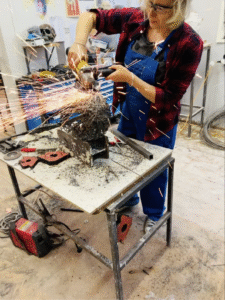
My pre-work equipment consisted of work clothes (long sleeves and legs are a must, and as it quickly turned out, a turtleneck would also be useful), heat-resistant gloves, goggles, a mask, and hearing protection (optional).
As you can see in the attached picture from the first day of the course, you can see the novice’s enthusiasm and a not-accidental resemblance to a knight-errant preparing to hunt a golden dragon.
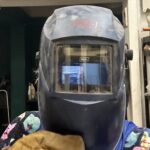
And there’s a lot of truth in this image. Each element of my “armor” was intended to protect against tongues of lava, electric shock, blinding glare, and excessive decibels. The psychedelic cats on my blouse were the equivalent of magical chainmail and were intended to distract the enemy. Otherwise, I didn’t take the whole thing entirely seriously on the first day. Unlike the knight-errant, who didn’t even have time to stutter as he fell from a dragon’s tail, I had no intention of fighting anything… except perhaps my own doubts, carrying colorful cats on me for courage.
I rarely experience the unusual sensation of feeling myself in my clothes. I rarely feel uncomfortable in my clothes. I have no professional reason to wear a uniform or my service uniform. I avoid (sic!) restrictive business attire like the plague, and when working in the workshop, I cover my everyday, rather comfortable clothes with only a light apron. Therefore, I can confidently say that, in various situations, my outfit doesn’t usually impose its will on me.
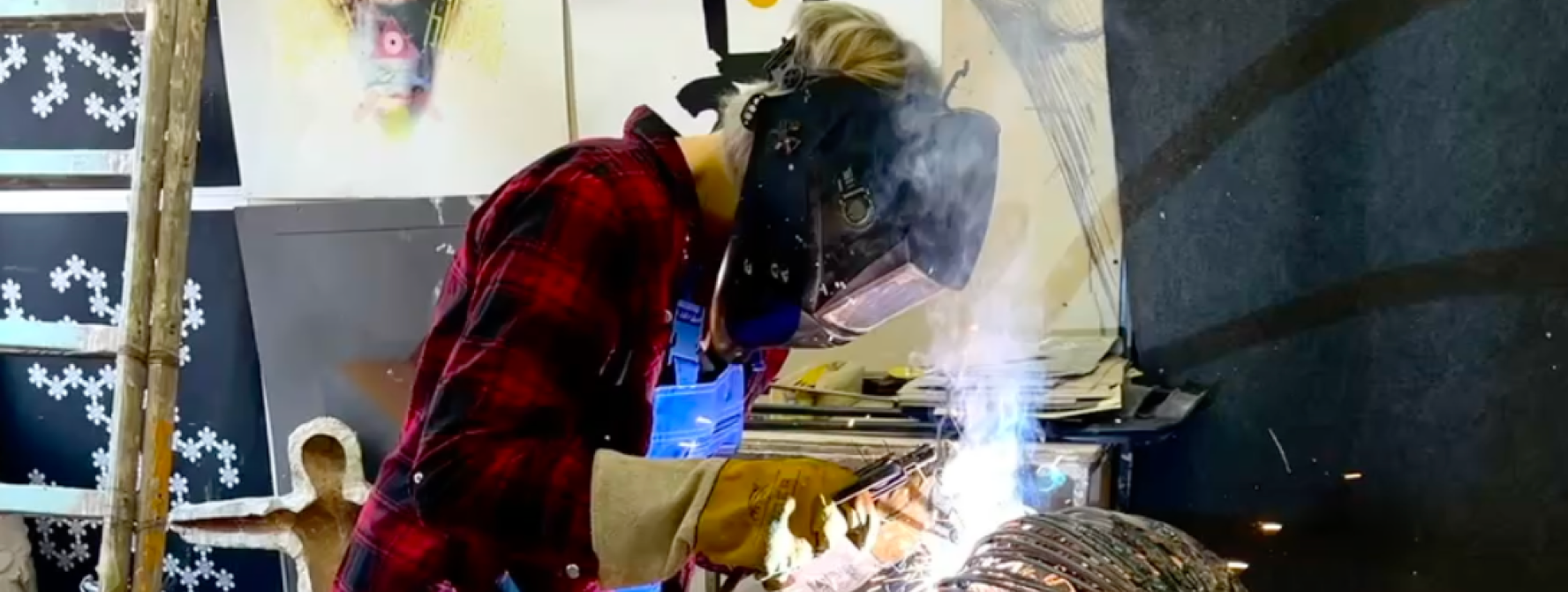
This time, during the workweek, the elements of my work attire became ingrained in me and became an integral part of the creative process. Entering the Sculpture Room in the afternoons, I would isolate myself from the day’s events with a thick, fireproof line, donning my “armor.” From the moment I put on the gloves and mask, the old worlds blurred, and for several hours I became a slightly different version of myself – the protagonist in a short story about welding. Encased from head to toe, with a narrowed field of vision, hidden behind a heavy mask that hindered spontaneous head movements, I felt more stable, but physically I felt that the cost of this protection was a reduction in freedom.
Several associations spring to mind for me regarding this experience.
In Salvador Dali’s “Diary of a Genius,” the author tells an interesting story (by the way, the title of the publication itself may suggest the tone of the author’s argument).
In one passage, Dali describes a morning visit from a guest to his home. The artist decides to greet the guest only after “wearing a Dali suit.” He adds that he never appears in public without his outfit, his style. Not only the distinctive mustache, but the entire style was carefully chosen each time, emphasizing the artist’s eccentric nature.
The relationship between social roles, identity fluctuations, subcultures, and clothing is an extremely interesting thread in social and cultural research. This year, I listened to several episodes of Karolina Sulej’s podcast “Ludzie w Ubraniach,” (eng. people in clothes) which I recommend as a side note!
In this context, among others, In psychoanalytic terms, our clothing is a form of self-expression and indicates what we want to tell the world about ourselves. It can also serve as a veil and constitute our Persona – tailored to how we want the world to perceive us, consciously or unconsciously. Truth be told, it’s probably both, or maybe something else.
Meanwhile, in my new style, the Knight Welderess of the BHP coat of arms, I was ready for my first challenges.
On the training path
When embarking on a journey, especially if it’s a journey into the unknown, it’s worth seeking the advice of those who often visit the unknown and become familiar to them. To put it less eloquently, before we tackle something ourselves, let’s listen to those who already know how to do it. Ideally, we should have the opportunity to practice under their guidance. This doesn’t mean that such a process is any less demanding. Having a mentor is a privilege, but it doesn’t eliminate the need for self-training.
The beginning of my training and preparation with the tools of the trade wasn’t the easiest. Despite a secure outer “armor,” I wasn’t fully protected from the inside. Unfamiliar with the noise, smoke, and smell of working with steel, I experienced considerable nervousness. The first sounds of the angle grinder and the hacksaw made me jump, which I couldn’t control. The sting of sparks falling on my head didn’t bring joy like sparklers at a party. I tried to control my paralysis and try to cut again, but I think I dissociated a bit and grumbled at first. Fortunately, there was no visible gritting of my teeth under my mask.
“I don’t want to, I can’t, it’s not for me,” I fought with a kind of determination that if I didn’t start, I’d never know… and then there were the others watching! But how to start, so that I wouldn’t overdo it? After all, this wasn’t a jousting duel, the courtyard of Kaer Morhen, or a kikimore hunt.
Slowly, with each new steel profile I cut in half, a greater sense of calm came over me… and I dare say even a sense of satisfaction. I was starting to enjoy it, like a game whose rules I’d quickly mastered.
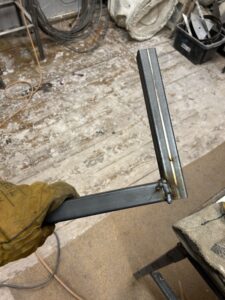
After cutting, it was time for welding. Here, too, after some initial struggles and a few blind spots, I began to discover small, glutinous successes. By the end of the day, I even had the courage to build my first sculpture from a few of the remains – The Wierdosh – Mirus piscis pospolitus.
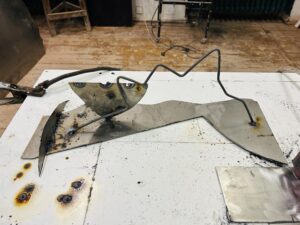
I didn’t desert. Tired but hopeful, I entered the second day of classes.
Half a day of poetry
Reading this collection of short stories from the world of The Witcher—published a few years ago as part of a competition run by Nowa Fantastyka—I can’t help but admire the skillful writing of the authors. I’m intrigued by what inspired them to so faithfully incorporate their stories into the world created by Sapkowski. The texts are at times unrecognizable from the original style. Is it due to the artistry and linguistic finesse of the writing, or perhaps the Witcher universe and its inhabitants are so expressive that they live independently in the collective consciousness of readers?
Or perhaps it’s the story itself… the very form of this world is so good that it holds up to many interpretations.
These reflections and this daring reading lead me smoothly to the next paragraph.
This is where form comes in.
As often happens during various workshops, I also arrived in Łódź with a list of ready-made ideas to be executed in metal. I don’t know what the plan was, but it was quickly revised. During Maciek’s course, I had to put my sketchbook deep in my backpack and start from scratch—from a blank page.
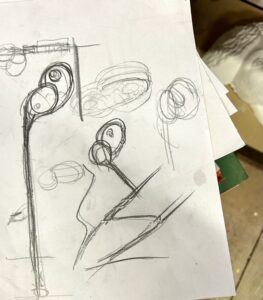
On the second day of the course, we were invited to engage in a counterintuitive activity to how I usually begin my work. Instead of turning ideas over in my head and analyzing them to extract concepts for sketching, I was to indulge in the flow of energetic drawing. Literally whatever came to hand. Without a clear goal, just in search of an interesting shape.
And so it was. First, there was emptiness. Then the first, rather shapeless, smear on a fresh sheet of paper emerged. A little casually, a little in defiance. The first doodle. Quickly, more followed.
As the saying goes, „It is better to go forward without an aim than loiter without an aim, and with surety much better than to retreat without an aim”.
After a long moment of struggling with my internal censorship, my scribbling picked up speed. A form emerged from the sketches that wasn’t anything concrete, yet it was something that sparked curiosity. Something with the potential for sculpture. The exercise itself was a great unlocking experience. I took it with me as an important lesson from the course. Now, the method of free-form sketching, or “doodle-ing,” is an important part of my conceptual practice, especially when I’m fixated on an idea and can’t seem to move on.
Doodle literally means a drawing activity done absent-mindfully. A sketch without the mind. A scribble. And yet, it’s in such mindless moments that the best ideas emerge!
It turns out that such aimless scribbling in the margins of notebooks, during phone calls, or lectures is also a subject of research. Analyzing doodles allows us to draw conclusions about how we work and even how we think. You can hear more on the Arts & Ideas podcast, in an episode about the fascinating phenomenon of “idleness.”
An interesting sculptural thread also emerged there. British artist Peter Rancall-Page utilizes sculptural clay doodles in his artistic practice. He sketches abstract forms and patterns in clay, and as soon as one form begins to resemble something, he puts it aside and works on another.
My little drawing doodle was an important milestone in this story.
Does anything resemble this shape? Maybe it’s like that pear… a pear has a shape too.
First welds and final touches
After a cursory review of the sketch, we decided that the strength of this form lay in its proportions, and ultimately, its scale would prove critical. After sizing the key design elements, everything flowed smoothly. Subsequent steps required careful attention to the material, allowing us to continually discover the soul of the design and the character of the final form.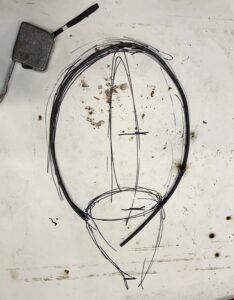
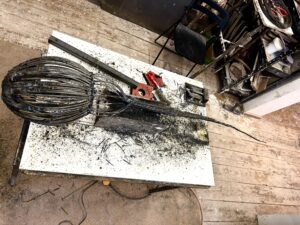
The egg-shaped, slightly twisted shape consisted of two parts – a large oval and its base. It could be formed in various ways from steel. Following Maciek’s suggestion, I decided to painstakingly cut thick wire and bend it to the desired shape. In this dense skeleton, the empty spaces were to be filled with weld, creating a unified object.
It quickly became clear that building the shape itself, while quite tedious, wasn’t as rewarding as the hours spent filling the empty spaces between the wires with weld. Any hopes of completing a perfectly filled and polished surface during the workshop evaporated.
However, I wanted to do as much as possible and use as many of the newly learned tools as possible. After all, I already knew the basic rules of the game…
Armed, trained, and carefully familiarized with a wire bender, angle iron, welder, and metal shears, I set out on the next few days of independent work.
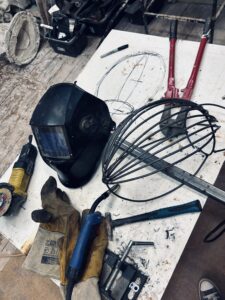
The time for the ultimate test came. Sticking electrodes, micro-explosions, miraculous escapes from dangerous burns, and the growing joy of improving fitness.
I would fall into sudden welding fits lasting several dozen minutes, working non-stop, only to emerge from under the mask, sunburned and with a certain alarming look of frenzy on my face. However, I quickly realized it was worth taking breaks, as I could become dehydrated and severely burned.
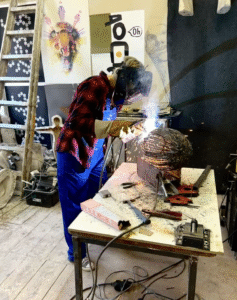
The shape may not be complete as in the original vision, but the form, scale, and proportions have been recreated in steel. I’ve brought the work (with Maciek’s support and supervision, of course) to a stage where further polishing is possible, but you could also say that it’s not really necessary. That it’s already quite good.
Starting from an impulse, I navigated a series of challenges and learned far more than just how to cut and bend steel bars. Ultimately, the lessons and experiences I learned coalesced into a story.
It wasn’t what I planned, but that’s what it turned out to be. Starting with a blank page, with a plan and no goal.
Epilogue
„There’s a destination at the end of every road. Everybody has one. Even you, although you like to think you’re somehow different.”.
Andrzej Sapkowski, “Sword of Destiny” (translation David French)
Almost two months have passed since the course. The conjunction of the spheres has once again opened a portal for my steel form. I sit and stare at it. After this rather lengthy explanation, it’s hard not to see it as some creature from the Witcher realm. Perhaps it’s a water monster, or the unhatched egg of something with a scorpion-like tail tipped with a poisonous thorn? Or perhaps it’s a large blue rosebud, or a fragment of a ship attacked by a kraken? You tell me, don’t you?
I wonder how many denarii of reward King Radovid of Redania promised for recovering this beast?
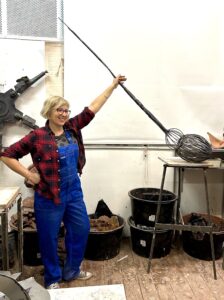
Bez nazwy, Łódź 2025 – Agata M. Nowak MORFIKA @Rzeźbiarnia