
Date added: 31/08/2025
City of Ants

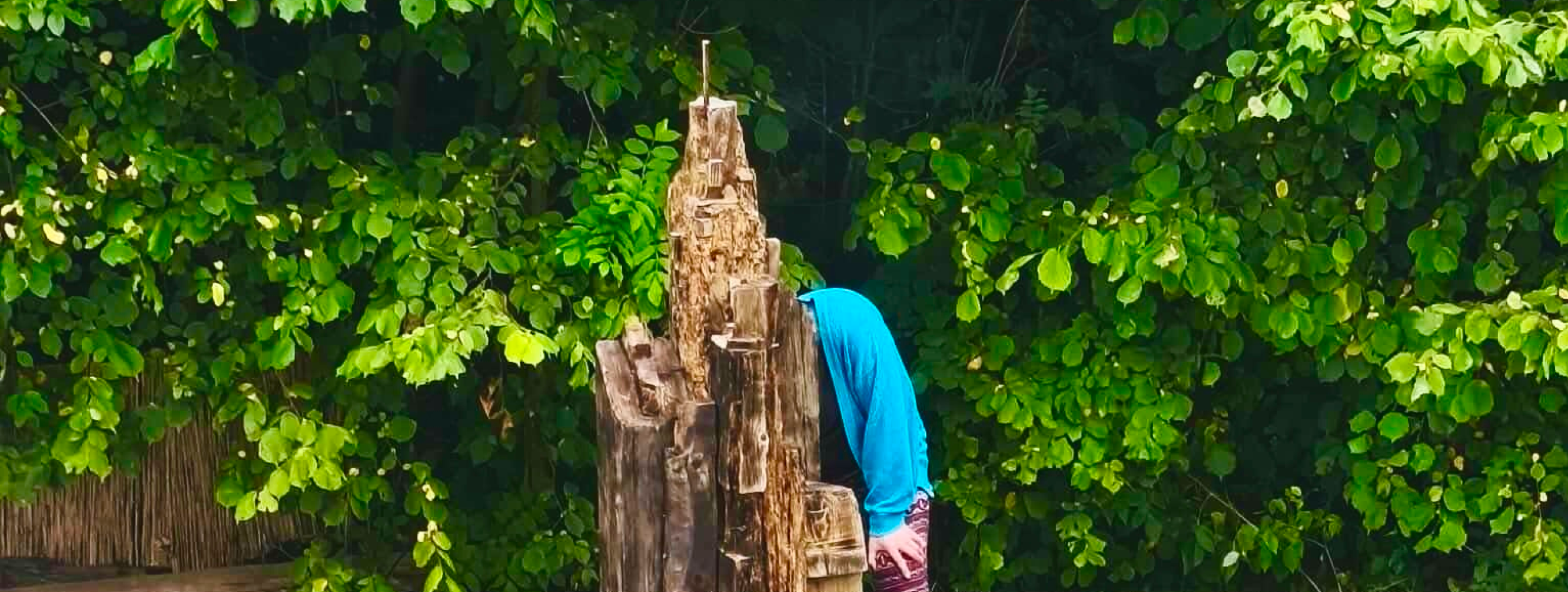
Welcome to Ant City – an innovative living space for colonies 2.0. Elegant estates with observation decks for guards and ladies-in-waiting. The Queen’s luxurious Palace, towering over the streets, is protected from any attempted coup. At the top of the buildings are convenient landing pads for flying members of the community, making takeoffs and landings never so smooth. Internal elevators and cranes will streamline transportation, allowing workers to effortlessly move through spacious, humid floors, adaptable for cultivating fungi and aphids. The organized urban structure is a far cry from the makeshift, seasonal “huts” of natural solutions. Ant City brings a new, improved order, comfort, and stability.
***
On the long August weekend, I went to an open-air workshop organized by the Sculpture House (Rzeźbiarnia) in Wyspowa Dolina. I arrived last and wanted to quickly catch up with the team working on their projects.“I was thinking about something like Ant City,” I blurted out halfheartedly after a short walk in the grounds.
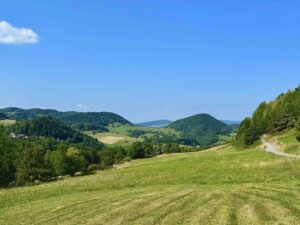
I searched for inspiration in the clearing. I searched for clues in the forest. I also looked hopefully into the valley, but honestly, besides “Ant City,” I didn’t have much on my mind. That was my first thought when I read in the event description that we would be working in the vein of Land Art— the Art of the Earth… not entirely familiar to me. Ant City appeared in my head like a signal, or a melody I couldn’t shake. Ants—little forest builders. Such a persistent thought, it wouldn’t leave me alone.
Despite, or perhaps because of, the absurdity of the idea, it proved to be a powerful “lever of imagination” and sparked considerable discussion. What could such a city be like, what would life be like there, and what would those involved think? Seeing the enthusiasm of my fellow sculptors, I decided to join in the deliberations.
The concept evoked a kind of inner trembling within me—oscillating between how much I wanted to take on the challenge and see the result, and the question “why?”
“Why Do Ants Need a City?”
I decided to dedicate this project to this question. Perhaps Ant City makes no sense, or perhaps it will reveal some meaning in conjunction with the exploration of Land Art?
On the construction site
In the clearing of Wyspowa Dolina, many rotten logs lay waiting to be removed – elements that had once been parts of a fence or a concert stage. Now, having served their purpose, weathered by moisture, wind, and sun, eaten away by mold, fungi, and insects, their forms were slowly disintegrating. From a structural perspective, their glory days were behind them. But from a creative recycling perspective, their glory days were yet to come!
The starting point for my construction project was finding that first, perfect log, reminiscent of the Empire State Building. A perfect landmark for the future empire. Then, all that was left was to delineate the city space, erect the first building, and begin the chaotic urban planning and expansion around it. Simple.
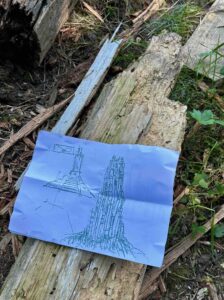
Construction of the Ant City was planned for three days. The plan involved creating a downtown area that would combine the New York skyline with the welcoming aesthetic of a termite mound. As sculptural consultations with Maciek Kus, who led the plein air workshop, I incorporated more hand-carved geometric elements into the design, which contrasted significantly with the organic texture of the “buildings.” By introducing detail on the gables—a clear sign of intentional human intervention in the decaying wood—I sought a visual language that would convey the impact of change. Small cottages and luxury apartments overlooking the entire clearing were evidence of a conscious design process, not the work of chance or the natural processes of a living ecosystem.
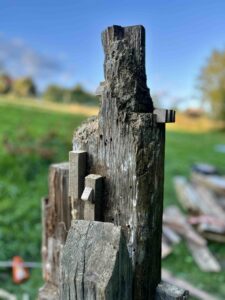
As the city grew, my inner tremors intensified.
I watched insects fleeing from the logs I lifted, panicking to leave their hiding places. Various unfamiliar bugs, beetles, and even… ants, scurried in all directions. Between the wooden logs and the grass, a damp, darkened space formed near the ground, naturally protected from the sun, teeming with large brown snails and pink earthworms, half-buried in the loosened soil. I tried to gently pull them off and place them safely, but let’s be honest, I couldn’t take care of everyone. I probably missed someone, unsticked someone too hard, or roughed someone up with my help during the relocation.
After all, time passed, and the city wouldn’t build itself.
Between the impulses that struck me with a sense of illegitimate intervention in the peace of other beings, another, increasingly powerful call appeared. A voice that drowned out my momentary doubts and drew me toward the result. Higher, larger, denser. Literally, a dream of power in a green glade. I began to imagine what builders and designers must feel during massive investments. And the 7 Wonders of the World? Striving for power equal to the gods? I experienced a small flash of power with five rotting logs; what kind of strength must it be when the stakes are much higher. Perhaps this is what Scorsese was trying to convey in his recent, rather (very) unsuccessful film, “Megapolis” (yes, I fell asleep).
For anyone who hasn’t built a city at least once, even with blocks or virtually in a computer game, I encourage you to experiment. See what the experience tastes like for you. And then it’s worth dwelling on it for a while.
Not simple but complex
What I experienced during the construction in the clearing was the act of consciously influencing reality. The natural world is subjected to so-called natural processes of transformation, which operate according to their own inhuman logic. They morph from one state to another according to principles that researchers, thinkers, artists, mathematicians, and children try to describe as best they can, with varying degrees of success. Conscious design intervention is a very human domain. We choose to introduce a new element into reality or transform it to induce the desired change. Also with varying degrees of success, often deviating from the anticipated.
In the spirit of design thinking, we can consider project implementation through the prism of opportunities and risks, technological feasibility, and the complexity of the situation in which the change is to occur. We can stratify situations into networks of dependencies and values of interest groups that will be affected by the change. We can define and examine their power, resources, needs, and importance. At least, this is how it is customary to consider “project stakeholders” in the world of design, among other things. As the scale of change’s impact on the status quo grows, complexity increases, interest groups multiply, and the power imbalance deepens.
In the practice of project activities, some project stakeholders may go unnoticed, unheard, and, in situations of foul play, deliberately omitted. Whoever defines the project and its stakeholders takes on the role of shaping reality and attempts to craft their own narrative. This can work, or at least persist, until resistance from those who convey a different narrative emerges. (As, for example, in the Icelandic film “Woman at War.” I recommend it!)
I imagine that cities, as they expand and modernize, are arenas for competing narratives, every day. From small disputes over a bench in the backyard, to the difficult histories of entire communities and the struggle to preserve their identity. All within the context of global needs, crises, and networks of economic and political connections invisible to the naked eye. Living in a city, it’s hard not to be entangled in something, no matter how hard you try. Cities, with their heterogeneous structure, offer a vast field for thousands of clashing interests.
Thinking about all this tension in the urban fabric can be breathtaking. Resistance to unconsulted change takes many forms. Art increasingly plays an important role in negotiation processes.
I heard one such story a few years ago.
Elephant and Castle
At the beginning of 2020, as part of the second edition of the Co-design Your Place educational project, I participated in a week-long speculative design workshop at the London College of Communication art school. In this multi-month project, implemented by the Stajnia Foundation, LCC, and Copenhagen Students’ House, I acted as a researcher, observing and describing the work of an international group of designers on revitalization challenges in selected spaces. It was in this context, a month before the outbreak of the pandemic, that I became acquainted with London’s Elephant and Castle.
Elephant and Castle, an area of London completely unfamiliar to me, is the area around a large roundabout, housing residential buildings, social housing, commercial spaces, as well as the London College of Communication campus, a cinema, and a Tube station. The city’s history dates back to the Middle Ages, and its name comes from an 18th-century inn located at a crossroads there.
At first glance, it seems like a metropolitan area like many others. During meetings with residents, however, our attention was drawn to the district’s ongoing major transformation and aggressive development investments in the area. Indeed, the construction sites, surrounded by large banners promoting the upcoming changes, maps, and design visualizations, effectively distracted attention from the heart of the area at first.
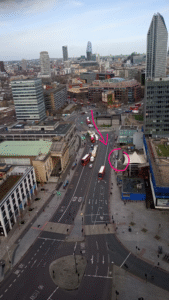
Elephant and Castle, Londyn, February 2020 – fot. AMN
Elephant and Castle is home to the largest portion of the UK’s Latin American community. The tiny Elephant and Castle, shown in the photo, a symbol of the district, adorned the entrance to the shopping center, which was the hub of social life for many residents. Small shops and locally-oriented services attracted visitors with their traditional products and offerings. Run by vendors from Colombia, Peru, Bolivia, and Ecuador, they cultivated fragments of familiar culture, creating an important new context for exchange and building relationships.
As it turned out during meetings with local activists, it was the Shopping Center itself that was to be removed in the redevelopment plans. The vibrant local initiative, Latino Elephant, which brings together activists and residents in activities for the district, fought to prevent the site’s devastation. Using a variety of resources, they sought an effective way to appeal to decision-makers for change.
One of the activities undertaken was collaboration with an artist associated with the London School of Communication – Luise Vormittag – who, together with residents, implemented the project “Walking the Elephant”.
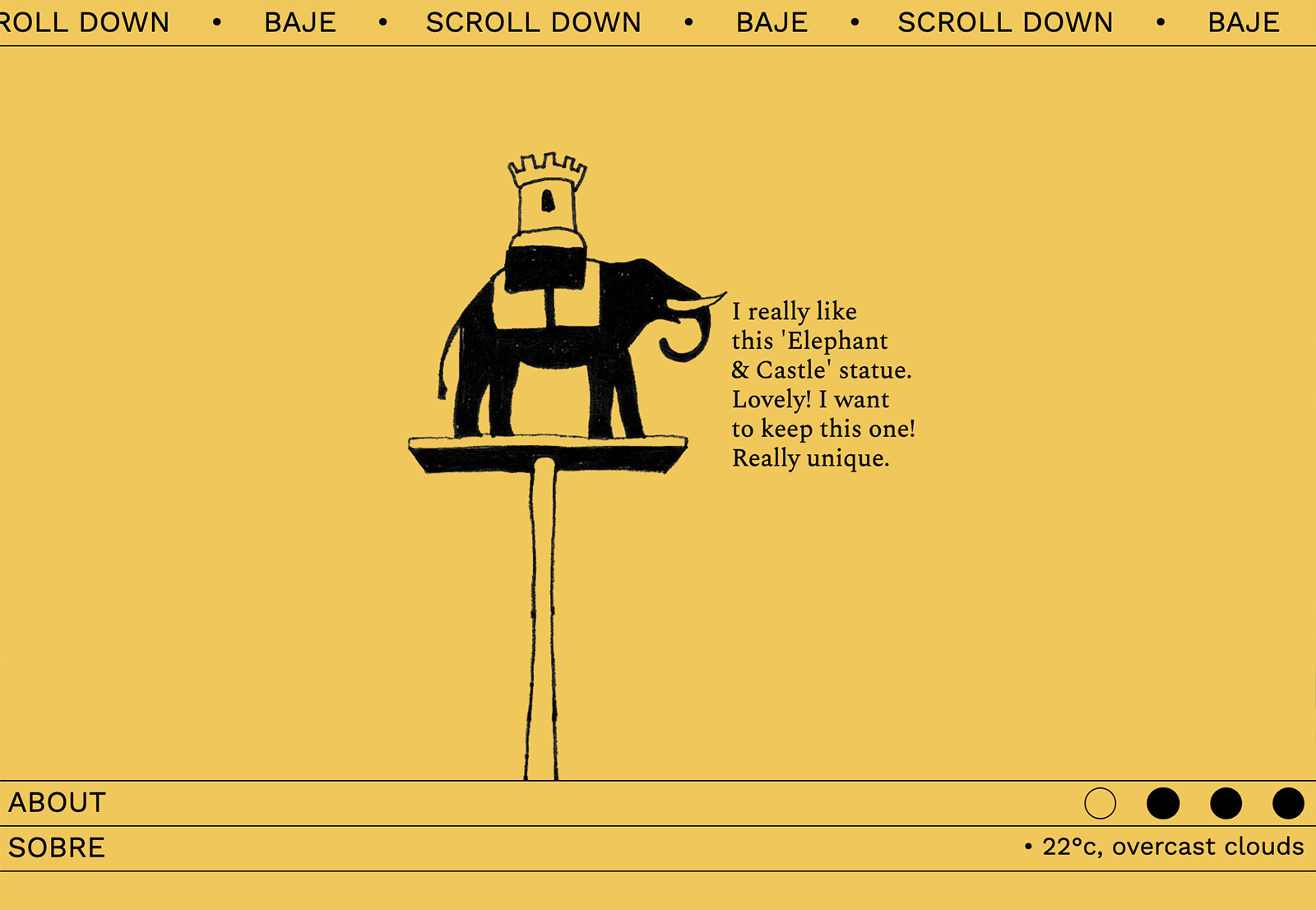
Screenshot https://latinelephant.org/walkingtheelephant/ Webpage designed by Luise Vormittag
A PhD student at the University of the Arts London at the time, she consulted with residents using ethnographic and artistic research methods. This helped her to understand their connection to the place and helped them raise their voices in its defense. Why was this initiative important? Language, as Luise emphasized during her lecture, was a significant factor in the discussion about change. Many residents lacked sufficient English to express their opinions and engage in conversations with the developers. The artist’s use of visualization and drawing methods allowed them to tell their stories more fully. Thanks to her knowledge of Spanish, Luise moderated the meetings, which resulted in the creation of digital documentation about shared life at Elephant and Castle, including the one taking place in the Shopping Center. Using illustration as her medium, the artist created an interactive illustrated website for the project and a series of leaflets that expressed what she had learned from working with residents. I was deeply inspired by this project and have recommended it many times as an example of socially engaged research and artistic work. I recommend exploring the project website and seeing the final illustrations.
While writing this, I returned to a familiar story to learn more. According to information found online on the Latino Elephant website, efforts to save the shopping center failed. After six years of campaigning to preserve the space, the center closed in 2022. Instead, something new was built across the street, where retailers were partially relocated.
The success of the Latino Elephant’s consistent efforts lies in building a powerful narrative. The needs were clearly expressed and heard then, and you hear them today. As the activists themselves describe it, they feel proud that they managed to hold the developers accountable for the changes throughout the negotiations.
“…we feel proud to have held developers Delancey and Southwark Council accountable throughout this long process. Every single concession was fought for tooth and nail, with the retention of small businesses in the main relocation sites…”
Perhaps (to shyly paraphrase Neil Gaiman) a story doesn’t need to dominate to endure, but it does need those who believe in it… and consequently, they walk alongside other stories, making their presence felt.
Return to Earth
After returning from the plein air, I did some research to gain some understanding of Land Art. I watched, among other things, Waldemar Januszczak’s documentary about iconic and ancient Land Art projects and read about the principles that guided this movement.
Land Art arose from a critique of the commercialization of art. It was also influenced by the strong ecological movements emerging at the time and the tendency to reject urban life in favor of a fascination with everything that seemed connected to rural life and nature. The works were, and are, embedded in the natural landscape, most often using materials and resources drawn directly from nature.
What surprised me upon first encountering them was the scale of many of the now-iconic Land Art works I viewed, given these principles. These are not simple things. These are often massive, massive projects that require a huge commitment of people and resources to come to fruition.
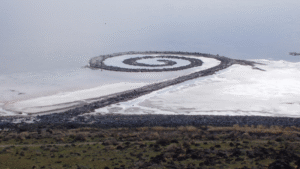
Spiral Jetty, Robert Smithson, 1970 źródło: Wikipedia
Land art works also encompass projects that, while existing outside gallery spaces and intended to challenge the traditional art market, influence the development of a new kind of market – the experience market. They often emerge thanks to wealthy sponsors, foundations, or fundraisers, and to experience them, one sometimes needs to embark on true expeditions deep into the country.
The land, as it turns out, also has something to say in this regard. Land art projects morph and transform due to the natural processes that occur around and on them. They become overgrown, flooded, and change color and shape. Depending on the season and time of day they are visited, they can appear completely different. Artists incorporate this possibility into their artistic interventions and, by maintaining photographic documentation, can archive the original concept before it succumbs to the Earth’s influence. Private collectors also purchase land for projects or invite artists to work on their land for months to acquire Earth Art.
The Earth’s influence on art ownership can be disappointing for collectors and art owners who imagined the story very differently.
“The process of commissioning, which is somewhat open-ended, always has challenges, always has problems to solve. Physical problems; drainage and weather problems. Decay problems. Animal problems! There’s always a problem that you have to solve along the way, and the collectors are part of that (…).We have sold some works that [are inherently prone to dissolution], but even the special collectors often get nervous when the work actually does disappear and morphs into something else.”
Mary Sabbatino, Vice-President, Gallery Le Long
Crater or Line
arth is an intriguing choice for a direct co-creator. This raises the question: what might the Artist hope to reveal through this collaboration?
“My desire is to set up a situation to which I take you and let you see. It becomes your experience.”
James Turrell
James Turrell, the renowned American artist, has been pursuing a vision since the 1970s that has already consumed decades of intense work and likely millions of dollars (starting with a Guggenheim Foundation grant). The artist desires to create a natural observatory. To (literally) touch the stars, he purchased and is developing an extinct volcano. Roden Crater is a project in Northern Arizona that has been developing inside a hill for over 40 years. The chambers, tunnels, and amphitheater being built there are colossal spaces, aesthetically reminiscent of the set design from Dune. The impressive scale of the observatory evokes ancient builders, and Turrell himself references inspirations such as Machu Picchu in his story, saying, “I do like the place that has powerful quality. What is that quality I’m not sure about?”
I don’t know the quality of the powerhouse either, but I can’t deny that the design, even viewed in a browser window, is breathtaking. As the artist himself claims, only by walking inside the world’s largest telescope, based on his concept, can we experience the physical and astronomical phenomena we learned about in theory.
“In order to care for something you have to notice it”.
Amanda Thompson
Coincidentally, around the same time Turell was perhaps beginning to sketch his vision of mastering light, Richard Long set out for a walk. In 1967, the British sculptor, an icon of early land art, initiated a project that evolved into a multi-year process of sculpting in nature.
A little grand finale
The projects described above, as well as my recent experience building the Ant City, form a reflection on the impact of change.
Land art practices reveal a certain paradox of working with the Earth, just as any act of introducing change into the existing reality is a form of paradox. Even a leisurely walk through a meadow has an impact. Walking with a purpose, or even without a purpose, we change the Earth beneath our feet. A walk through a meadow can also change something within us.
A redevelopment project in a city can improve something, but it can also be an act of violence. In a complex reality, it is likely both, depending on the perspective.
The act of influence is not indifferent. And it carries various meanings that we may not notice.
What if Turell shows us not a cosmic reality, but rather an ant’s perspective? After all, a volcanic crater resembles a giant anthill. Perhaps, sitting in the chambers of a large telescope built inside, we experience the cosmos as an ant experiences the sky through a crack in a pine needle? What if Richard Long’s rocky path in Peru connects with the illustrated path the Peruvians traced while walking around their Elephant and London Castle? What if everything is an illumination?
The Ant City led me to this confusing place where I begin to sort out the seeds of meaning. As the city was built from fragments of a wooden fence, a new story also arose from fragments of new experiences, memories, fantasies, and information. I would like to believe that a real and practical potential also emerged in the clearing. Some species of ants establish anthills in decaying trees. New queens either fight and kill the current one or leave to establish their own colonies. In nature, a truly bloody struggle for survival sometimes rages. Perhaps small royal stakeholders will find their way to the City and inhabit it. Why wouldn’t this scenario be likely?
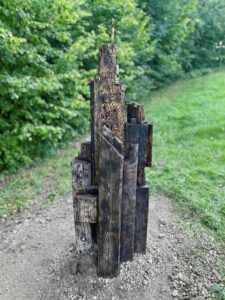
City od Ants, Agata M. Nowak, Wyspowa Dolina 2025